You might remember a note that appeared in PropTalk’s April issue: a reader, Al Townsend, reached out to me after coming across an article on our website about a navy chief who had recently bought a 1981 trawler to liveaboard at the base in Groton, CN (proptalk.com/deltaville-chincoteague-beyond). Turns out, the boat featured in the article used to belong to Al!
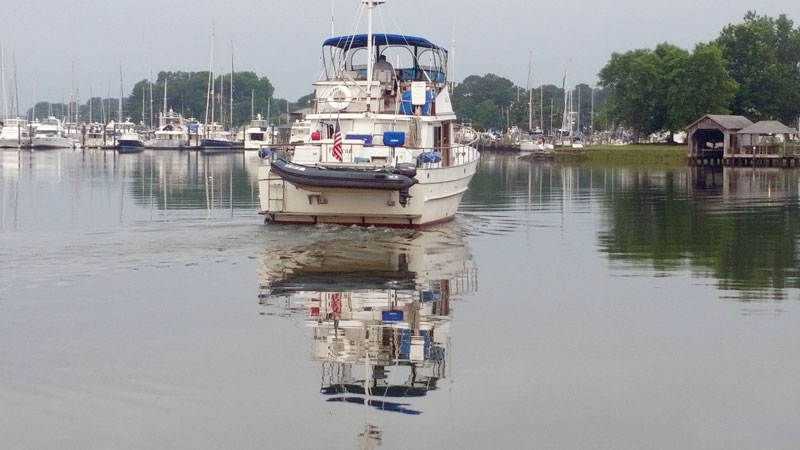
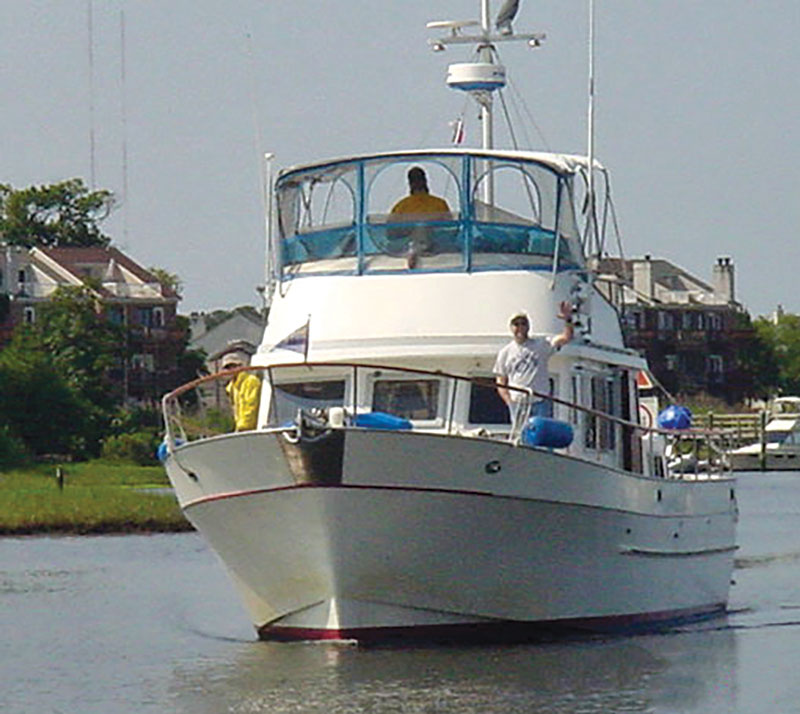
We were able to connect him with the new owner, Joe Roberts, and the two swapped stories about their time on Pelican, a 1981 41-foot Present Trawler. Al and his wife Meredith owned her from 2001 to 2019 and Joe from 2022 to 2025. We caught up with Al to discuss their many wonderful years on Pelican and their love for the Chesapeake Bay.
“We bought Pelican in the spring of 2001 at Lambs Marina in Jacksonville, FL,” says Al. “We had a boat previously, a Carver 3227, which was a lot of fun but a completely different type of boat from a trawler. Over the years we developed a wish list of what we were looking for.”
Ultimately, they wanted a single diesel engine for ease of maintenance, because “amazingly you have to fix boats occasionally,” joked Al.
They also wanted more usable room inside the boat, a galley down, and an actual salon for a living room. The couple anticipated taking extended trips rather than living aboard, but they still wanted it to feel homey. Al shared how the Carver was a great boat but that it burned 25 gallons an hour traveling at a cruising speed of 18 knots. Pelican on the other hand, with its displacement hull, burned two-and-a-half gallons per hour cruising at seven knots.
“We found that it didn’t really pay to be in a hurry on a boat,” says Al. “We enjoyed the actual time on the water as much as we enjoyed getting there, so if we didn’t get there as quick, it wasn’t the end of the world. And we certainly enjoyed burning a tenth of the fuel.”
But that came later. Because they did not have experience with the trawler lifestyle and didn’t even really know if they would enjoy cruising at seven knots, they chartered a boat with Blue Goose Charters. Turns out, they loved it! They chartered for a week out of Baltimore and cruised the northern part of the Bay. After that trip, Al says they started looking for a boat of their own.
Al was initially tempted to buy a trawler that was close to what they were looking for, but it didn’t check all of the boxes. Lo and behold, while visiting family in Charleston, SC, they decided to take a detour to Jacksonville, FL, to just “take a look” at a boat called Pelican.
“It was the perfect boat,” says Al. “It had everything I was looking for, all the creature comforts, and it was in very good shape for its age (20 years old then); very well maintained. It had some problems, but there’s no boat that doesn’t have some issue, and they were all serviceable things we could take care of. We made the arrangements and never looked back.”
Al and Meredith headed up the Intracoastal Waterway to bring Pelican home, which he says only added to the fun of their acquisition. And the journey was so much more “civilized” compared to their previous boat. Al says, “We had gotten as far up as North Carolina and Meredith says, ‘I’d really like to take a shower and get ready for dinner,’ and I said, ‘Why don’t you go ahead and do that?’”
It hadn’t occurred to her initially that she could in fact take a shower while they were cruising, or that cruising on Pelican meant they weren’t “bouncing through the waves and holding on for dear life.” It was a very different experience. Pelican was 41 feet and the bathroom actually had a bathtub; very civilized indeed.
“She had a semi-displacement hull with 13 tons of displacement,” says Al. “I used to refer to her as a ‘full-figured lady.’”
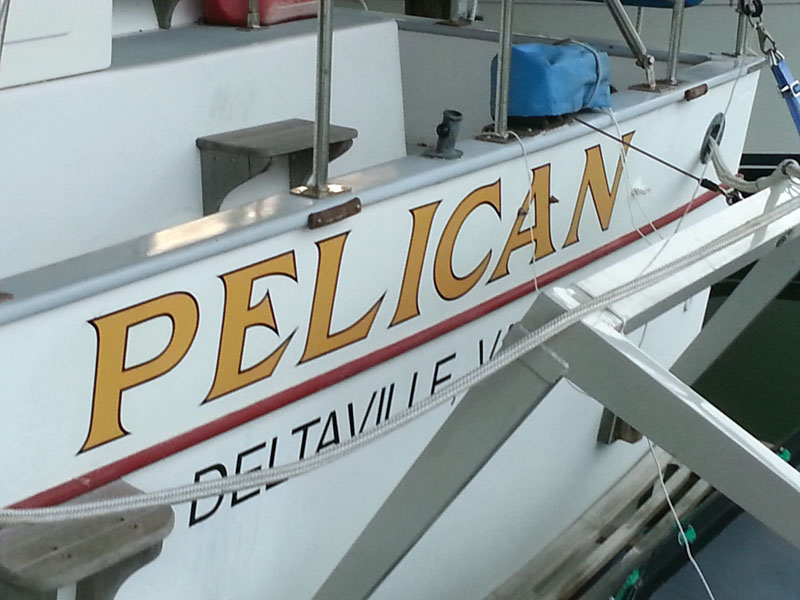
As mentioned, the boat was named Pelican when they bought her and they kept the name (as did Joe, the next owner after Al). “I am a firm believer that it was named that way for a reason and it belongs to stay that way,” he added. “It just kind of rang a bell when we first saw it; we said, ‘that’s a great name.’ We thought the name felt very calm and reassuring.”
They eventually brought Pelican up to Virginia, where Al was originally from, even though they were living in Piedmont, NC, at the time.
Water in His Blood
“I was raised in Hampton, VA,” he says. “My father, prior to World War II, was an oysterman out of Wachapreague. So, I don’t know if I was fooling myself (with Pelican), but I thought I had water in my blood, as part of my heritage.
“My father got a job in a shipyard; he couldn’t get a job in the Navy because of an injury sustained tonging for oysters for 16 years. During the war, my grandfather ended up selling the oyster boat and then coming out of the war it was almost impossible to find another boat. It was also highly unlikely for my father to be able to go back into his previous trade, so he went into an alternate field.
“He always had a love for the water, and by the late 50s he had found an old Chesapeake deadrise workboat, I think possibly in Urbanna, VA. I think he bought it for $600, which was a fairly big investment for the 50s. But he didn’t do stuff frivolously. We used the boat all through my childhood and I never remember a circumstance where we went out for fun; we were always going out working to put food on the table.”
They kept the boat in the harbor in Newport News, and that’s where Al spent a lot of his early years, “floating around in the Hampton Roads.”
“It was a lot of fun,” he says. “I had a great time doing that as a youth. And my dad, remembering how he learned to be a waterman from his dad, taught me how to care for and run the boat. By the time I was 10 or 11, I was the primary pilot of the boat.”
Al says the whole experience of being at the helm was very confidence inspiring. “We saw the other fancy boats, the cabin cruisers, and I think my father sort of scoffed at those, the weekend warriors. I loved the workboat, and I really enjoyed our work,” he added.
The Cruising Lifestyle
Talking to Al, you can really feel how much those early experiences on the water meant to him. And they clearly influenced his later years with Pelican and his love for the water.
The longest Al and his wife ever spent on Pelican for one trip was six weeks. They had a bunch of trips that lasted two or three weeks, but Al says the longer trips were a great deal of fun.
“We used to jokingly say that if we took a week to go boating, we didn’t get on ‘boat time’ until Tuesday. You take off on Sunday and there’s a panic to remember everything and get everything loaded. You start thinking, ‘What’s that noise?” and ‘Is the boat doing okay?’ You calm down around Tuesday. And then by Thursday you start thinking about work again. So basically, out of a week you get two days of ‘boat time.’ On a longer trip, you may have eight days of relaxing boat time.”
In 2005, Al and Meredith were “happily ensconced” in a marina in Morehead City, NC, which was about two to three hours from where they live in the middle of the state. They would commute down to the boat and they really enjoyed Beaufort, but they found that there were not as many places to really travel.
Al says, “Having the memory of the Chesapeake Bay in my bones, I thought, let’s go back up there.”
He had visited family up there but hadn’t been on the Bay since his father passed away and the boat was sold.
Coming to the Chesapeake Bay from Morehead City was a three-day cruise, and Al found that it was pretty much time to head back just when they were getting settled in. It was about this time that they found out their marina in North Carolina was going to be sold. With no other marinas in the area checking all of their boxes, they had a decision to make.
“My wife said, ‘Look, every time you get on the boat you want to go to the Chesapeake Bay, so why don’t we look up there?’ That was when I had a ‘duh’ moment. I could drive an extra hour or two but save three days in transit getting to where I wanted to go.”
They settled in Deltaville, VA, which had “600 residents and about 3000 boats in the water.” A nice ratio, according to Al.
They originally took a slip in Dozier’s Marina right inside the mouth of the harbor. They stayed for a year and became really good friends with a couple, Dave and Joy, who had a Grand Banks. That couple kept their boat in Deltaville Yachting Center which was more protected inside the creek, so Al and Meredith moved there and stayed for the next 14 years.
In Deltaville they were docked on the Rappahannock River and loved how close they were to the main stem of the Bay. “A half hour cruise and then look at all the places you could go,” says Al.
Their first stop was usually Tangier Island, and they went dozens of times. Al says they really enjoyed getting to know Milton Parks. “We were very much on a first name basis with Milton and went to church with him on the island.
“All the people that came through there, he never got the names wrong. He told me his secret was to call all the men George, and he called the ladies ‘Love.’ He called everybody by those names and he’d never miss.
“He was one of the true characters of the Bay, a real delight. Such a great fellow, always happy.”
Tangier is 27 miles from Deltaville, so Al says it was great for them to come out of the Rapp, go around Windmill Point, and then set a course for NE and come right into Tangier. They sold their boat in 2019 but returned to Tangier Island by ferry in 2022.
“I remember that last visit, he was full of stories as usual,” says Al. “His humor was just amazing. He could quote Shakespeare and Rodney Dangerfield in the same paragraph. He was such a bright spot in our memories.”
Making connections such as these was something Al and Meredith really came to appreciate later on. They met so many different people over the years, but they all shared a love of being on the water.
“We saw so many places that most people don’t get to see,” says Al. “You see things from a completely different perspective on the water.”
They rarely tied up in marinas and would anchor out as much as possible. They might be in a harbor where they could dinghy over to the dock at night or other times they would find a place where there wasn’t another soul around, no light flare on the horizon. There were so many places to explore and so many places where they found you could have it entirely to yourself if you really wanted.
They would often return to old favorites (such as Annapolis, Cambridge, and Crisfield), but they also made a point to find new places and had many great memories over the years.

As Al mentioned previously, there was occasionally work that needed to be done on Pelican, but thankfully he was a mechanic for his day job which helped a great deal.
“We get spoiled with our cars because they are relatively bullet proof,” he says. “People don’t realize how much time and maintenance you have to spend on a boat just to keep it seaworthy. Pelican was no different but having a single versus twin engines meant less issues. She had a Ford Lehman engine, and they were as common as dirt in the old trawlers; they were just about bullet proof if you changed the oil.
“With a boat, if it wasn’t broken at the time it was going to be breaking at some point. We’d leave and everything would be working great but then by the third day the A/C would break, and we’d have to figure that out. You need to really know what you’re doing, and I think that’s intimidating for people when they get started. You can’t just pull into a garage out on the water. It’s nice to feel a little more self-sufficient when you’re out there.”
Those might be the realities of boating, but Al doesn’t say that to intimidate people, and at least for him, the good always far outweighed any of the downsides.
“Being out on the water is an adventure,” he says. “You’re doing something not everyone can do, you’re depending on your own skills, either fixing something or navigating. I think there’s a sense of human satisfaction that you’re still pulling this off. There’s a certain amount of accomplishment we can enjoy. I think that has a real draw to it for people, plus there seems to be a universal love of the water.
Coming to a Close
Al is 75 now and they sold Pelican when he turned 70, though it wasn’t an easy decision. “Being a mechanic,” he says, “I spent a lot of time crawling around engine compartments and my ability to get in there was waning. I wasn’t as limber as I used to be. My wife said, ‘Maybe it’s time to consider that this chapter is coming to a close.’
“We realized that in order to maintain the boat as we wanted to, it wasn’t going to be as practical. And we didn’t want to start paying people to do it because that ran counter to my work ethic. I think all boaters eventually have to come to that point.”
Pelican had been maintained very well and was in good shape when they eventually sold her. They were hoping that someone who loved trawlers specifically would find her. And boy did Al and his wife love this trawler.
“A big day for a lot of the boats in our Morehead Marina was going over to Beaufort for lunch and then turn around and come back. I always thought, how can you have such a nice big boat and not take it anywhere? My mentality was if I had a boat, I wanted to go somewhere.
“The experiences that we’ve had over the years, we never would have had them any other way We’d never have met the people or seen all the places we’ve seen.
“My wife and I met in our 50s and we’ve been married for 26 years. When I met her, her idea of a good time was a weekend hiking in the mountains, and she took to the boat life really well. She said her wildest dream before this was to find someone with an RV. I just said, ‘You got an RV, an RV on the water.’ I wouldn’t trade it for anything.”
Al’s son, now 35, convinced him to look for Pelican and that’s how he connected with the next owner, Joe. Al says his son was not always thrilled about boating in his teenage years, namely because he enjoyed the ‘fast boat’ as a little kid and did not find the ‘slow boat’ quite as fun. Fast forward to now though and he’s the site manager at the MarineMAx Lake Wylie Marina in Charlotte, NC. “His boating heritage came back to him,” says Al. But most surprising of all, he told his dad that he was fantasizing about buying Pelican back one day…
“I wouldn’t put it past him,” says Al. “He has so many stories; I didn’t know he was paying that much attention.” So, while the boating bug may have taken longer to stick for Al’s son, it’s clear Pelican left a lasting mark on the entire family. We’re standing by to see if she returns one day.
By Kaylie Jasinski