From time to time I ponder existential questions, like “why is there air?” and “how much deeper would the ocean be if it didn’t have so many sponges?” I even wonder how my life would be different if my father had introduced me to sailing at a young age rather than powerboating and I had become a sailor.
I suppose I could be a multi-millionaire, having saved all that money I put in the fuel tanks of my various boats. Or maybe not. I do know a lot of sailors and some of them are even my friends, and they are not millionaires. And, I have sailed from time to time and once in a while I think it may be fun, even a lot of fun. But then I think back to my sailing experiences and say “Nah.”
One of my first sailing experiences was in Florida on my father’s sailboat. (Yes, he eventually joined the sailing set, thus disavowing all the life lessons he taught me). We were in Fort Pierce, and he offered to take us out through the inlet and sail on the Atlantic for a couple of hours. It lasted about 15 minutes. Right after we left the slip, I immediately got queasy and turned a shade somewhere between slate gray and olive green. He tried to help, telling me: “keep your eyes on the horizon” and “take the helm and steer for a while” but to no avail. We skedaddled back to the marina, and it took many years before I set foot on a sailboat again.
Adventures With Friends
I did somewhat admire my sailor friends, using their skills to trim the sails, point the boat into the wind, tack and gybe, and all the other things they did out there on the Bay. On one particular occasion our boating group was on our summer cruise, traveling from Tilghman Island to Solomons. The sailors got up at the crack of dawn, made coffee, and headed out. The powerboaters slept until 9 a.m., went out to a leisurely breakfast, and left the marina at 11 a.m. or so. We passed the sailboats at 11:20, three miles from where they started from, and got to Solomons by about 1 p.m. We were in the pool and on our third or fourth Mai Tai when the sailors arrived at 6 p.m., soaking with sweat and looking like they had run two marathons.
I innocently asked, “Did you have a good sail?” Their reply: “The wind died at noon, and we were fighting a three-knot current on the nose, so most of the trip we were moving backwards!” “Okay…” I said, “sounds like you need a cold adult beverage, I’m buying!”
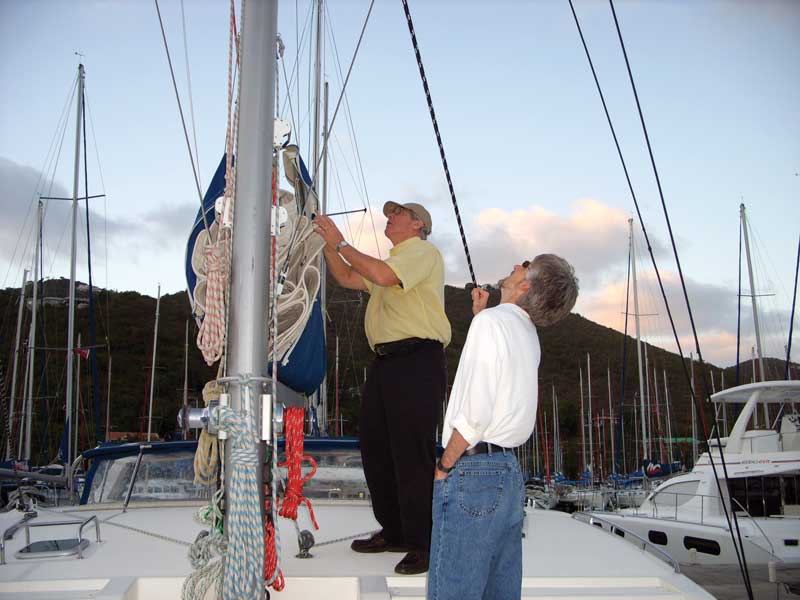
Fast forward to a few years later when four couples decided to charter out of Tortola in the British Virgin Islands. There were two sailing couples and two powerboat couples, so of course we chartered a sailing catamaran. But it did have two small diesel engines, so there’s that.
Each morning of the charter went like this:
Sailor number one, looking up at the top of the mast: “I think this is the main halyard.”
Sailor number two: “No, that’s the topping lift.”
Sailor number three: “Let’s pull on it and see what happens.”
Sailor number four: “I don’t think we need the main sail, let’s just let out the genoa.”
Powerboater number one: “What’s a topping lift?”
Powerboater number two: “What’s a genoa?”
Powerboater number three (me): “Let’s start the engines and get moving; we have places to be, people to see!”
I was always outvoted, and we sailed everywhere because one of the rat fink powerboaters switched allegiances and sided with the sailors. So, we sailed and sailed and they even forced me, under threat of walking the plank, to take the helm! By some miracle I didn’t run us aground or cause an accidental gybe, but the whole experience reminded me why I was a powerboater.
This unpleasant memory faded and a few years later, once again on our summer cruise, I had a chat with one of the sailing couples after a 15-mile leg across the Bay. On this occasion the wind was uncharacteristically brisk for July on the Chesapeake, and I surmised that this couple had a blast zipping along, silently and inexpensively on a beam reach whilst the powerboaters had to bash our way through some fairly nasty, choppy seas to get to our destination.
I asked what I thought were the proper questions: What sails did you use? What was your top speed? How many times did you have to tack? etc. Their response: “It was too windy, so we motored the whole way.”
I didn’t really know what to say, but I started to suspect some of my sailing friends were closet powerboaters. So, as a public service, I offer the following advice to any sailboater who decides to switch over to powerboating.
Advice to Sailors
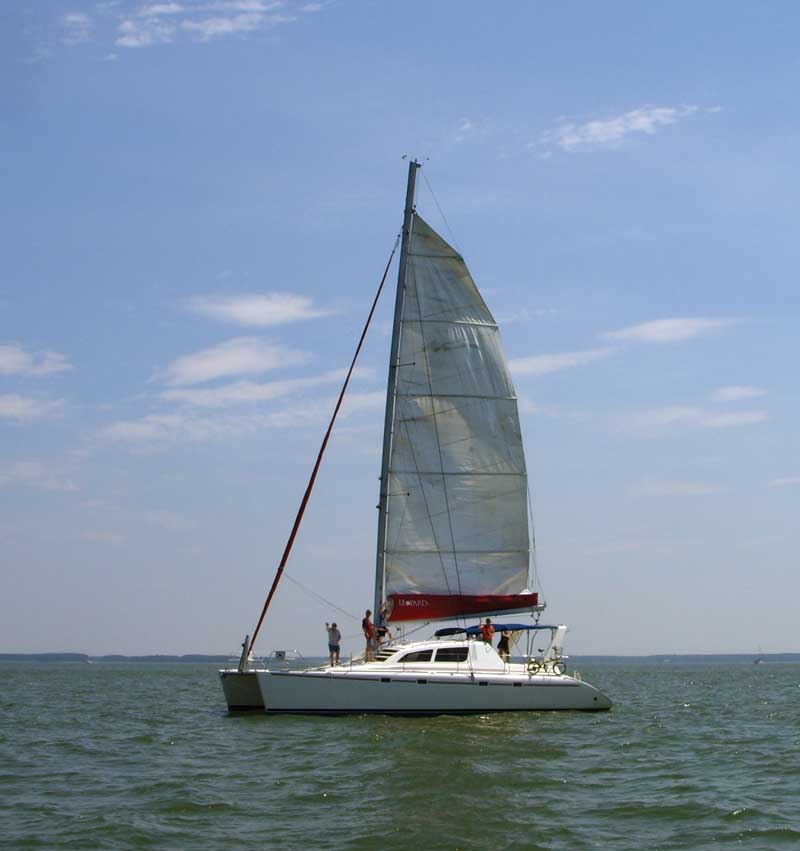
There are many reasons to switch, but the primary one seems to be advancing age. Obviously, as we get older, our reflexes aren’t as quick, our eyesight is not as sharp, and our memory is not as good. It makes a lot of sense to move to a powerboat at this point where there are no sails to raise, booms to dodge, furlers to un-jam, or complicated sailing rules of the road to remember.
But first, the former sailor needs to realize that fuel is no longer free. Before you take the plunge and buy that powerboat, take out your wallet and burn half the money in it. If you can do this every day for a full month without crying, you’re ready to move on to the next step.
Step two involves the noise. No more peace and tranquility; get used to the drone of an engine! Try this: Remove the muffler from your car and take a long trip, say 300 miles or so. If you still feel reasonably sane and there’s no ringing in your ears after the trip, you are ready for step three.
The next step is designed to accustom you to the way a powerboat handles the seas. A sailboat’s displacement hull generally plows through those bumps with a gentle up and down bobbing motion whereas a planing powerboat will pound. Here’s what to do: Jump in the car (still no muffler, right?) and head out for almost any road in Pennsylvania. Do this for about three hours. If none of your fillings have rattled loose, it’s time for step four.
Step four is to go ahead and buy that powerboat. Now, some claim that driving a powerboat is boring compared to sailing and there is some truth in that statement. That’s why powerboaters invent ways to make things more interesting, like having someone strap curved planks to their feet so they have an excuse to drag them around behind the boat using a rope with a handle at the end, under water, until they give up and let go.
Another pastime involves buying expensive rods, reels, and bait which gives the powerboat owner license to lie to his friends later at the bar about the size of the fish he almost caught. Other powerboaters relish the idea of burning hundreds of gallons of fuel whilst collecting playing cards in the vain hope of winning enough money to pay for fuel to get back to their home marina.
At any rate, once you have made the transition, you may, in fact, miss the sailboat. Here are a few tips to help you get over this feeling while you are driving that new powerboat:
- Throw a couple hundred pounds of bagged sand in the boat, just on one side, and switch it to the other side every time you make a turn.
- Have one of your crew toss a cup of cold water in your face every few minutes but have them wait until you are not looking.
- Whack yourself on the temple with a whiffle ball bat every time you change your angle to the wind.
- Tie a short piece of rope around your waist and secure it to the closest rail every time you get up to move.
- Whenever the wind is less than five knots reduce your speed and take the engine out of gear and sit there for a few hours.
- And finally, shake your fist at any other powerboat that goes by without slowing down.
Congratulations, you have made the transition successfully! You are certain to enjoy many, many hours afloat on your new powerboat!
By Gary Armstrong