It was a cool Saturday in May of 2023 when I decided to drive from Annapolis to Shady Side, MD, to check up on my boat, Soul Rebel, a 1995 Chaparral 2550 SX (read more about his boat-buying journey at "Finding Your Dream Used Boat is Just the Beginning") that I was in the midst of restoring to begin the process of making her ready for the 2023 boating season. All was well as my fiancé, Hannah, and I drove the 40-some miles. We arrived around 5 p.m. and began uncovering my pride and joy (which I had not seen for almost 12 weeks). I unclipped the full mooring cover to reveal her cockpit cover which I similarly unsnapped. I began to unroll the canvas forwards towards the bow when—to my absolute shock and horror—I noticed the port-side (passenger) windshield was uncharacteristically frosted. Perplexed, I pressed further, discovering smooth pebbles of crystalline material on the carpet. I took a closer look and realized the tempered glass windshield had shattered. I sat there stunned, wondering how and why it had happened.
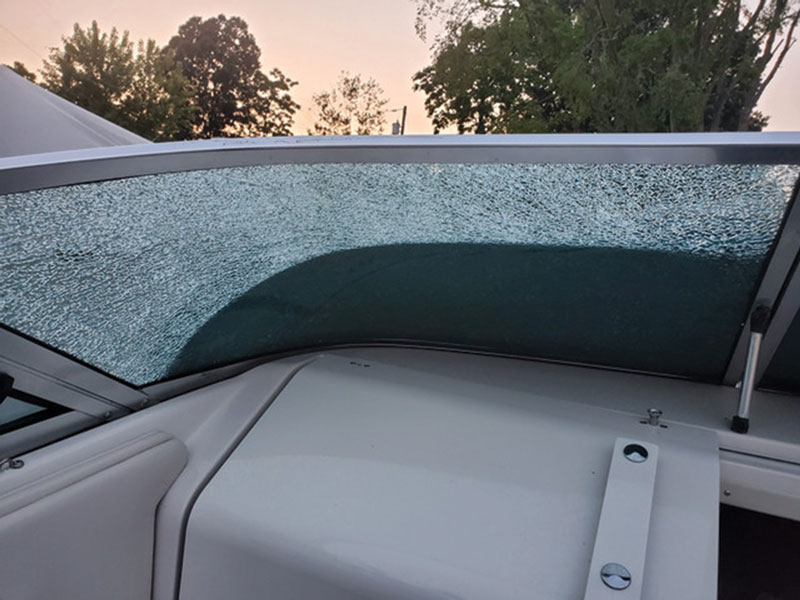
Both Hannah and I were shocked and dismayed, wondering what we could do. After investigating and deliberating for an hour or two, I covered the boat back up and we left—leaving the boat to sit for a while, while I began the process of documenting what had happened with our insurance company by filing a claim and taking many pictures of the carnage.
As the weeks went by, we eventually returned to the boat to clean up the mess
which necessitated making matters worse before things could, mercifully, get better: i.e. we had to further “break” the broken windshield—which had shattered into a million tiny, rounded pebbles—in order to remove and then dispose of the glass. Such a process was very time-consuming, taking an estimated four or five hours of labor. Despite our best efforts, I still occasionally find a small piece of glass every once in a while.
Covered by Insurance?
Once the glass was carefully removed and disposed of, we covered the boat and left, needing to wait and see what would ensue with our insurance. Backing up a bit in our narrative (as in before we removed the shattered glass pieces from the windshield frame): an insurance adjuster had come to our boat to inspect the damage and probe for obvious, probable causes; but despite his best efforts, no obvious cause was found. Such is the nature of windshield damage I would come to learn.
It so happens that tempered glass can spontaneously shatter due to any number of factors including: temperature changes that cause layers of the laminated glass to expand/contract out of sync with one another; acute manufacturing defects (that often go undetected for decades); impact from an environmental hazard (like a flying/falling tree limb or branch); or even water penetrating the frame and freezing, thereby expanding and exerting pressure onto the glass. Tempered glass is a miraculous material that is incredibly safe and resilient—that is, until suddenly it is not. All told, the adjuster was unable to determine a direct cause but thought that it could have been due to a manufacturing defect that had been exacerbated by the winter conditions.
Nonetheless, because vandalism and/or damage from an environmental factor (like flying debris) could not be ruled out, the windshield was mercifully covered by our insurance policy. But as weeks turned into months, the adjuster was having a difficult time sourcing a replacement, so I began doing my own research.
The Lowdown on Boat Windshields
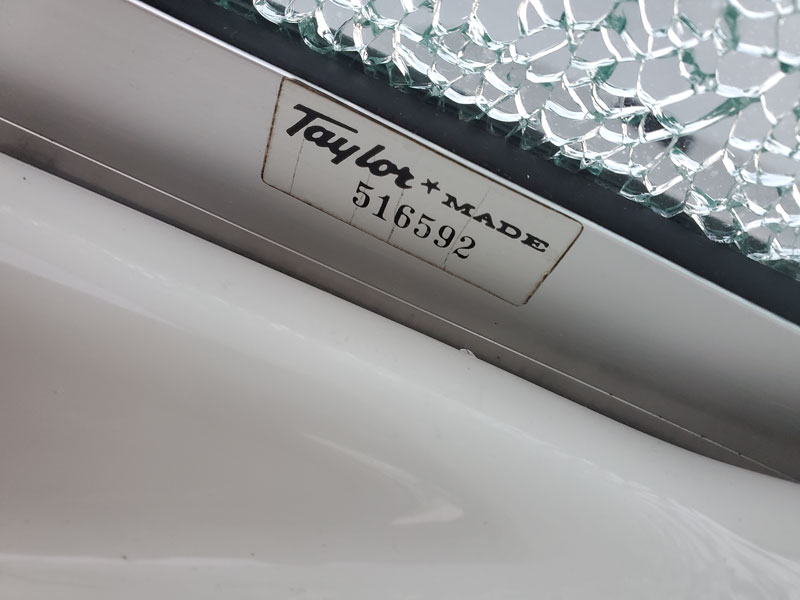
Curved tempered glass windshields for boats are typically made by Taylor Made (at least in the USA). Our windshield had a sticker with a Taylor Made part number stamped on it; as such, I phoned Taylor Made to ask if they had a source on a replacement, but they did not. I then browsed eBay (thinking someone might have a replacement pane from a similar windshield section that could be adapted to work). That is when I learned that boat windshields are in no way universal but instead can even vary somewhat year-over-year on the same model of boat.
Thus, I decided to call some custom glass manufacturers and quickly learned that no standard glass (or auto glass) shop could fabricate a very specific piece of curved tempered glass (as they rely on a proprietary mold). Upon doing so, I also learned that many folks opt to replace their broken windshield with a plastic or plexiglass (acrylic) alternative—polycarbonates such as Lexan are also used with some frequency. Compared to glass, hard plastics like acrylic and polycarbonate are very durable and impact-resistant—though it should be noted, they lack hardness and therefore scratch resistance. If I were to design a boat windshield, I would be very tempted to go with marine plastic for its superior impact and shatter resistance, which I feel grants the user greater safety, as well as a much lower initial cost. While such materials are not impervious to surface degradation (and yellowing in the case of polycarbonate), they can be rehabbed or replaced quite easily by a person of reasonable skill.
Taking great pride in my vessel’s condition, which may be described as “better than mint,” I could not stomach the thought of replacing proper marine tempered glass with a cheap plastic alternative (but this is on me and solely a personal preference). Moreover, seeing as only one pane had miraculously shattered of its own accord, I desperately wanted to directly replace what had been there, especially considering the frame had been spared any discernible damage. But what one wants and the practical reality one finds oneself in seldom align. As such, what was I to do? Partially without a windshield, the boat was unusable (for me at least), and the 2023 season was quickly being lost to the time-bending gravity of insurance claims; the adjuster was also at loss as to how to proceed.
Odd Problems Require Creative Solutions
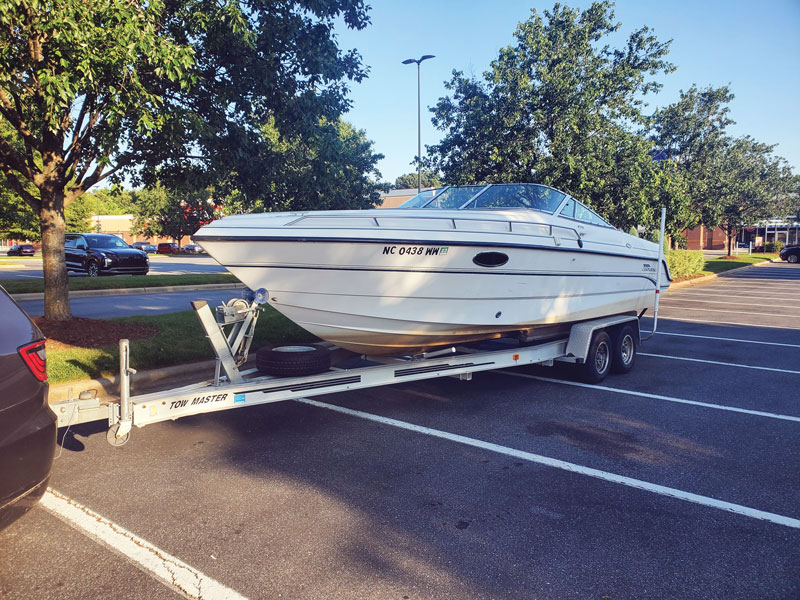
I hope I now have you on the edge of your seat, dear reader. Midway through the summer, Hannah and I began contemplating the best course of action. Our “solution” came about when my childhood best friend, Brandon, sent me a link to a post on Facebook Marketplace with a listing for a 1994 Chaparral 2550 SX. It was listed for a measly $4300 and located on an inland lake in North Carolina.
When I initially viewed the listing, I was a bit stunned: the boat looked to be in above average condition, which made its price a bit of a quandary. I sat on it for a few days before taking action. Eventually I called the seller, whose name was Mike, and he seemed like a decent guy. By late June, Hannah and I arranged to travel to view the boat and make sure it was in good condition—if we were to take on such a vessel to cannibalize the windshield, I wanted to make sure we didn’t get stuck with a lemon. Thus, I inspected and sea-trialed the boat with Mike. I also conducted an engine compression test (which the engine passed). At first, we were unsure about what this potential purchase would mean. Would Soul Rebel be totaled? If so, would we buy her back? Would we keep this other 2550 SX as a second vessel for use near Hannah’s parents on the Great Lakes?
With so much uncertainty, we returned to Annapolis to get back to work and continue to mull over our options. Searching the internet and calling around, I was able to find one company who custom fabricated tempered glass sections for boat windshields from undamaged frames: Ocean Dynamics based in Miami, FL. Upon calling them, it was determined that to custom fabricate the broken section it would cost in the ballpark of about $11,200!
By early July it was clear that neither insurance nor I would be able to source a pre-made direct replacement; further, since the adjuster fhad asked me, I told him plastic was not a satisfactory replacement. As a result, the adjuster began to work on the claim with the outrageous price from Ocean Dynamics, which was undoubtedly in our best interest. Thus, I felt that we had the “go ahead” to purchase the other 2550 SX to cannibalize it for its intact windshield. And so, I called up Mike—who was in the midst of selling and moving out of his lakefront home—to offer $3000 for the boat (which had no trailer). Mike, clearly in no need of cash and in a hurry to meet closing deadlines, happily accepted the offer.
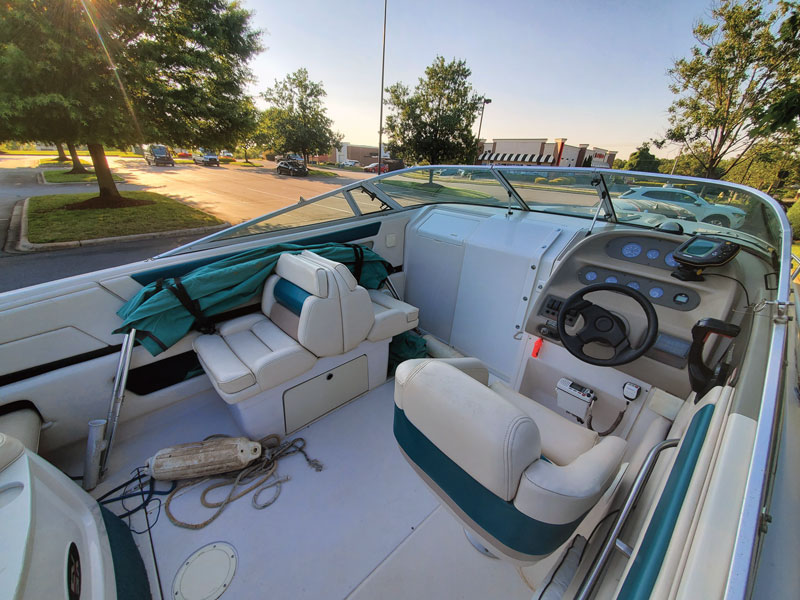
With that part complete, we had just two weeks to hook up the trailer to launch Soul Rebel, put it in a slip with a boat lift at our marina, and then drive our empty trailer southbound to North Carolina to pick up our “new” 1994 2550 SX.
Putting Plans into Practice
The rest of our tale from here on out may seem a bit anticlimactic: on the one hand, we did what we set out to do—i.e. head south to pick up our new vessel, making it back without further complication—but the truth is that we were just beginning to fight a battle against Fate and Fortune that would be hard-won.
Upon returning to Maryland with our new boat in tow, we had to begin the onerous task of replacing the windshield: something I had never done nor even considered. I soon came to learn that rather than one piece, a windshield is comprised of dozens upon dozens of custom-fabricated glass castings and aluminum or stainless steel frames (which are also modular in nature)—all held together with innumerable fasteners, tracks, and foam/rubber gaskets that ensure the assembly does not shatter during the course of normal operational vibrations. Thus, we soon learned that getting the “new” boat was one thing; removing its windshield to fix Soul Rebel’s was quite another.
I started by removing the broken section’s framing from Soul Rebel to give me an idea of how the frame attached to the vessel; and in so doing, I soon learned that there were lag screws through the vessel’s deck underneath the foam gasket (whose function I deduced was to seal out water). Equipped with such knowledge, I was able to remove both vessels’ forward passenger windshield sections (including frame) without much fuss. But to remove the sections was one thing, to be able to fit a replacement section—which required the perfect matching of integral slides into tracks of the two adjacent, corresponding sections—was another thing altogether.
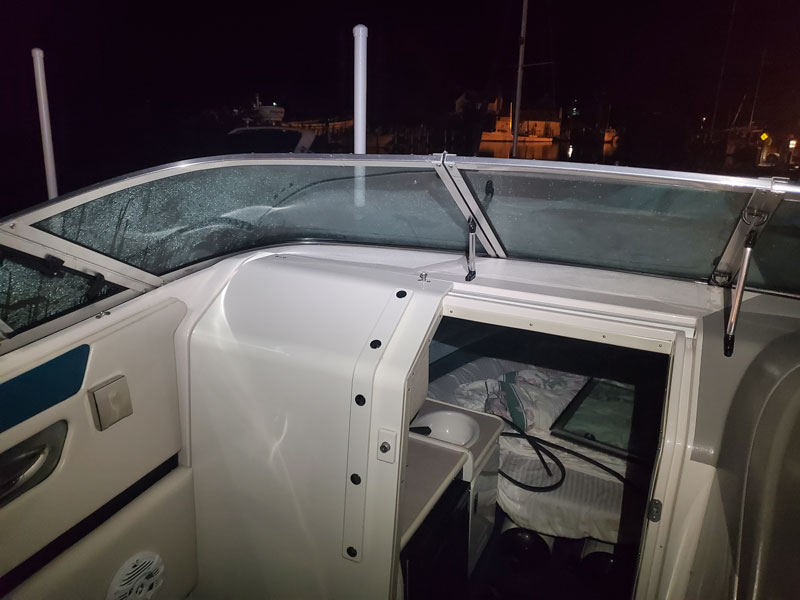
From the onset, I had decided to not remove the unblemished glass from its frame, but to instead replace the whole panel—frame and all. This decision necessitated I remove nearby sections from their lag-screwed moorings so that I could match up the tracks before fastening the whole windshield down as one Frankensteinian assembly. It became clear that I would have to drill many new holes and fill others with epoxy to seal them. Upon beginning work, Hannah and I soon learned that while the plan was sound, actually putting it into practice would be more difficult than initially anticipated.
Boat Repair is a Journey
Thankfully, after a few evenings of labor the broken windshield section was replaced. With the repair complete, it was time to finish the process of making Soul Rebel ready for the 2023 season: i.e. de-winterizing the boat, changing the engine oil and filter, changing the gear oil (which required playing “musical boats” by putting our new 2550 SX on the lift so Soul Rebel could rest on the trailer), and replacing any and everything that I otherwise found to be lacking. During the 2023 season, we wound up not launching the boat in Maryland but trailered her 1000 miles to Michigan to explore two Great Lakes in Hannah’s backyard: Michigan and Superior, respectively (you can read about these adventures at proptalk.com/across-northern-lake-michigan).
To sum it all up: boat repair is a journey where one never knows what one might find or how things might go. In our case of the broken windshield, we came out better than before. Yes, we lost most of that season to irksome boat repairs, but we received a hefty insurance payout that allowed us to purchase another vessel which we benefited from in a twofold manner: by cannibalizing its windshield and thereafter selling it with disclosure as a donor boat for its engine, outdrive, and other mechanical bits. In all, we were able to pocket some money for our troubles; all we had to sacrifice in return was our time.
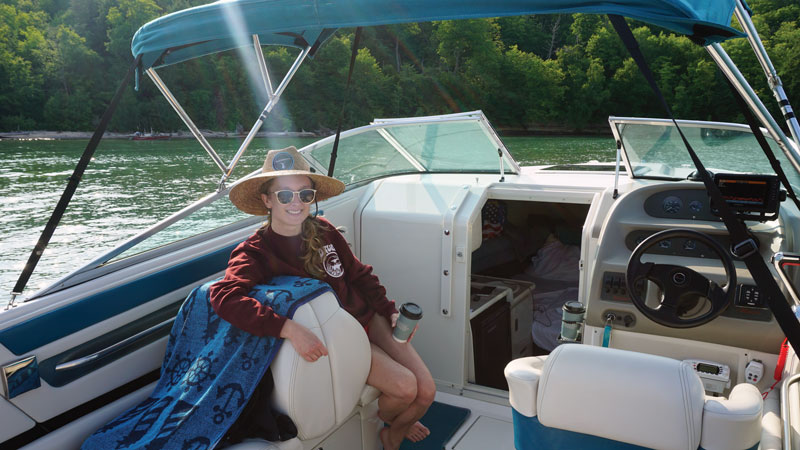
I did not even have to feel bad about using the other boat for its parts, as we later found extensive stringer damage/delamination in the bow section. One should always be leery of old, cheap boats as they are frequently more trouble than they are worth.
However, for now the broken windshield remains fixed. The 2023 season came and went, bearing fruit in the form of truly great and novel experiences exploring waters which I never dreamed I would have the opportunity to explore. Upon returning to Maryland from Michigan with Soul Rebel in tow, it was time to undertake another momentous project: that of numerous gelcoat, fiberglass, hull/deck joint, and rubrail repairs—but that is a subject for another day. Fair winds and following seas to all who undertake their own roundabout boat repair voyages!
About the Author: Drew Maglio is a writer and avid boater who has owned 12 boats to date over his 31-plus years. After graduating with his MA from St. John's College in Annapolis, Drew turned his love for boats and all things boating into a career path: first as a marine mechanic and general shipwright, operating Capital Boat Works—now as a marine surveyor, operating Capital Marine Surveying. Drew lives with his wife, Hannah, in Annapolis, MD.