Grandfather puffed his corncob pipe and gazed out toward the harbor. “Well,” he replied slowly, “the first thing to do is get all the bad stuff out. Then, you can begin rebuilding her.” He meant restoring an old wooden boat: remove the rotted wood first and then replace it with sound material. Grandfather had been, for many years, a wooden boatbuilder, now retired. He ran his thumb across the blade of the steel block plane that I had found at a flea market and proudly handed to him—the first real tool for the boatbuilder’s toolbox I hoped to assemble. His nose wrinkled slightly. “Dull as a hoe,” he said, handing it back as if it were a dead mouse. My confidence sank. This endeavor, I realized, was going to take work. My landlord, Jeff, who had spent years in the marina and boat business, was no more encouraging. When I told him about the old wooden motorboat, he said, “I wouldn’t give them 500 bucks for it.” What had I done?
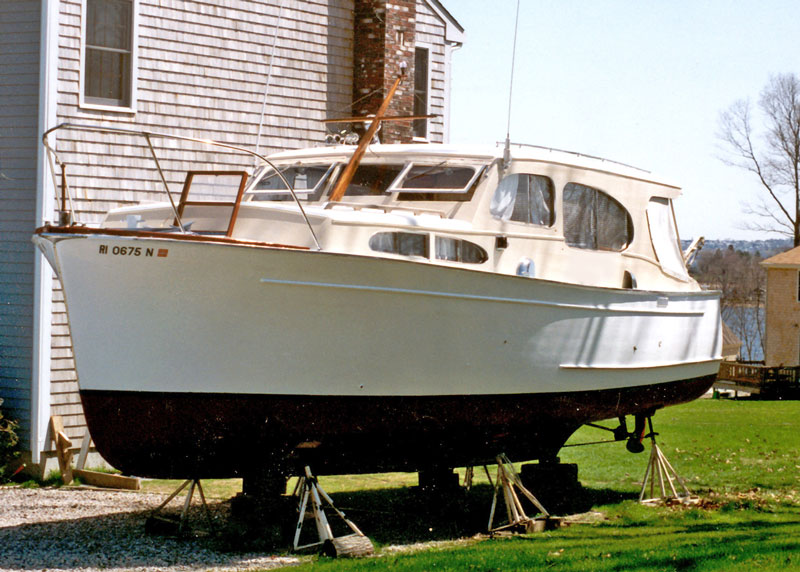
I had bought a 33-foot wooden “sedan” cruiser. She was built in 1952—or, judging by her appearance, perhaps shortly after Noah’s flood. She was propped up in a field near a highway roundabout in southern New Hampshire when I first saw her, looking neglected and forlorn. She was a typical cabin cruiser of her era, with a plump hull and round bilges that gave her an unpleasant tendency to roll in even a mild beam sea. Power came from two flathead six-cylinder Chrysler Crown marine gasoline engines with Zenith updraft carburetors. They clicked and purred smoothly, like sewing machines, with little vibration, but both had a healthy thirst for fuel. Back then, a round trip to Block Island—about 25 miles each way—cost roughly $100 in gasoline. Today, it would easily cost three times as much, with 12 cylinders pushing her displacement hull through the water at a top speed of eight knots.
Back then, I was young, energetic, and broke. I was willing to work hard; sweat equity would be the currency that bought my boat. I found woodworking tools at flea markets and yard sales. Acquiring a large sailboat was financially out of reach, and the few repairable ones around were usually snapped up by better-funded, more enterprising boatbuilders. But I had grown up in boats with my grandfather, and he had taught me a few things. I assumed he could teach me more and guide me through restoring this boat—my first truly sizable wooden one.
The first boat I restored was only 16 feet long, a wooden lapstrake Penn Yan or something similar with an old outboard motor. She became 15 and a half feet after I cut off her rotted transom with a chainsaw and built a new one from two pieces of plywood sandwiched and epoxied together. One afternoon, cruising Newport Harbor with friends during the annual Folk Festival, I saw a big wooden cabin cruiser at anchor, her transom facing the music ashore. She was weathered and clearly of 1950s vintage, but a half-dozen people sat in chairs on the afterdeck, cocktails in hand, enjoying the show. She had a cabin, probably a head, bunks for resting, and an overhanging coach roof for shade. I had none of this. They even had a door one could walk through to go below to the toilet. Civilized, I thought. This was the sort of boat I wanted. The thought became a dream, and the dream a passion. A few years later, I had a similar boat—all I had to do was fix her up. People looked at the boat and then at me, as if I were crazy. It was unsettling.
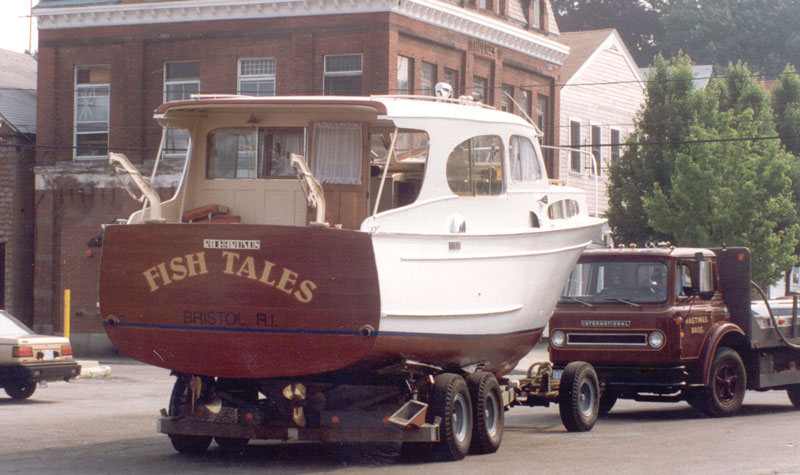
I had her hauled home and propped in my backyard, where I ran extension cords out from the house. A cast-metal plaque on the transom, partly masking an air vent, announced “Richardson.” I had never heard of Richardson. Of course, I knew Chris-Craft (who didn’t?), but over the next three years, as I became an apprentice backyard boatbuilder to this Richardson classic, I learned a great deal about the make of the boat and about backyard boat restoration.
George Reid Richardson had founded this well-known powerboat company in the Buffalo, NY, area, building boats particularly suitable for the Great Lakes. Quite possibly its most distinctive and popular model was the ‘Cruisabout.’ Mine was not exactly a ‘Little Giant’ Cruisabout—those were earlier models—but she belonged to the same long line of solidly built Richardson powerboats, constructed of western red cedar over oak frames and trimmed with mahogany. The Richardson Cruisabout was really a line of classic, pre-World War II wooden cabin cruisers built in North Tonawanda. Renowned for their elegant craftsmanship and mahogany interiors, these boats (typically ranging from 28 to 33 feet) were built of cedar over oak and featured comfortable onboard living spaces.
George Reid Richardson (1879-1937), or more accurately G. Reid Richardson, never ‘George,’ was born December 13, 1879 in Midland, MI. After graduating from high school, he began his boat building career at the Bay City Yacht Works in Bay City, MI. In 1906, he moved to North Tonawanda, NY, to work as a foreman for the Niagara Motor Boat Company. In 1909 he set off on his own and created the Richardson Boat Company.
The Richardson Boat Co. was established in 1909 as an exclusive cruiser builder, no runabouts. G. Reid Richardson died in 1937; around 1959 it was acquired by United Marine, Inc., and became their Richardson Boats Division, but it closed for good in 1962.
The cruiser that made the company was the 28-foot model nicknamed the “Little Giant.” These were introduced in 1920 and were made for many years. Powered by a Gray 93-hp gas engine, their top end was almost 30 mph. Some boats had a 92-hp Chrysler. This boat was famous for its escorted cruise from the factory to New York City via the Erie Canal and then down the Hudson River.
Over the course of 52 years, Richardson established the company as a major boat builder, employing at times more than 200 workers, and earning commendations from the federal government for its work during World War II. The Richardson line included a full range of custom and production cruisers, sailboats, and runabouts, in addition to work boats and military craft.
For almost two years, I worked like the devil on my new boat. When I didn’t know how to do something, I read up on the subject, or asked people, or improvised. My grandfather passed away early on in my project, sadly; I felt very much alone after that, but found consolation in asking myself, on occasion, “What would Gramp do in this case?” Quite often, after pondering the issue at length, an answer would come, and it was usually the right one.
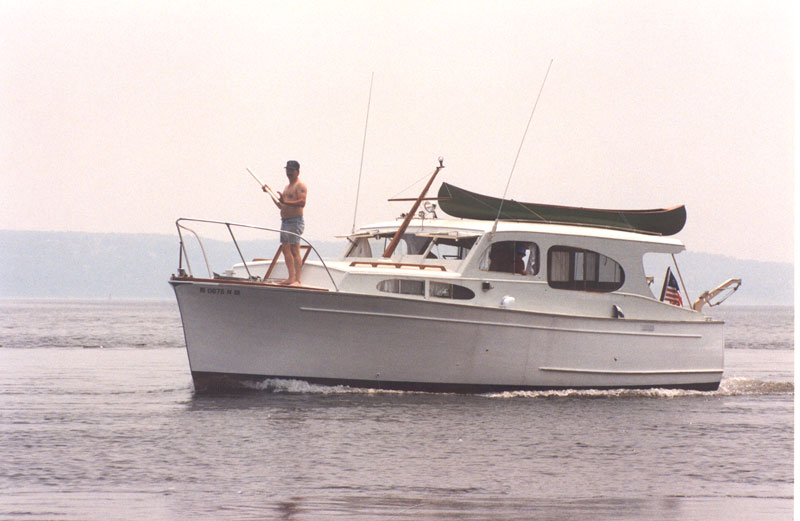
The first time that I took her out for an all-day run, up and down Narragansett Bay, with friends aboard, she ran well, but I realized that her engines needed some work. Black motor oil leaked into the bilge, and there were a few other indications that the engines needed some attention. After having been referred to a gentleman, the late John Dubickas up in North Tonawanda, a mechanic who had serviced the engines in Richardson cruisers for many years, I decided to bring them to his shop. When I saw his engine restoration work, I realized that he was, at the very least, the right choice. I would bring them to him, even though it was to be a long trip.
I built a scaffold around the stern of the boat and used a chain fall to lift these 700-pound-plus (each) motors up, out, and down over the transom and into an open trailer waiting below. Once they were secured, I hitched the trailer to my pickup truck and began the 500-mile journey to his Duby Auto and Marine shop. Six months later, they were rebuilt and ready to re-install, with even the copper fittings polished and gleaming. I drove out there once again and hauled my motors home through the Berkshires in a blinding snowstorm on the Massachusetts turnpike.
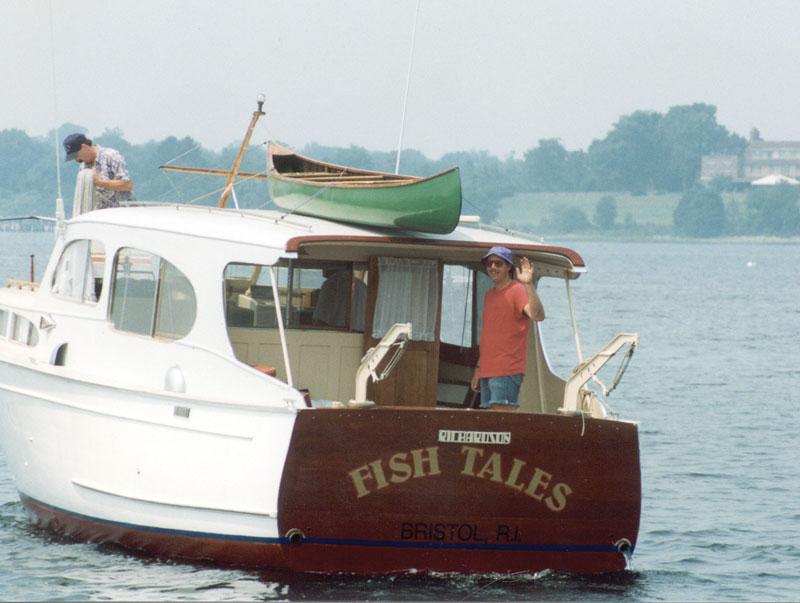
Those Chrysler Crown marine engines were solid beasts. They were raw water cooled, and had suffered from rust corrosion, so John installed sleeves in the cylinders and downsized the diameters of the pistons. I bought and installed “Sen-Dure” cooling towers for each engine so that I could turn each engine’s cooling system into a closed-loop freshwater (antifreeze) system, with raw water pumped through each engine’s cooling column to capture the heat. I went through a lot of zinc pencils over time, but the system worked. Each engine’s raw water pump became its antifreeze recirculation pump, and I installed up-to-date Jabsco pumps to bring in the raw seawater. Six-volt generators were replaced with 12V alternators. The starter motors, both six volt, were fine with the 12V system; they simply spun a little faster. When all was finally done, we launched her, after naming her Fish Tales, which was the name that my grandfather had given all of his motorboats. We enjoyed her for a number of years before selling her, and although she had entailed a lot of work and restoration, I never regretted my choice of buying and restoring her.
By Capt. Mike Martel