In July of 2025, Anodyne, an MJM 43zi, departed her home port in Annapolis, MD, and headed to the Great Lakes with a goal to reach Isle Royale on Lake Superior and then return home. Our voyage lasted three months, covered 3500 nautical miles, and encompassed parts of four of the five Great Lakes.
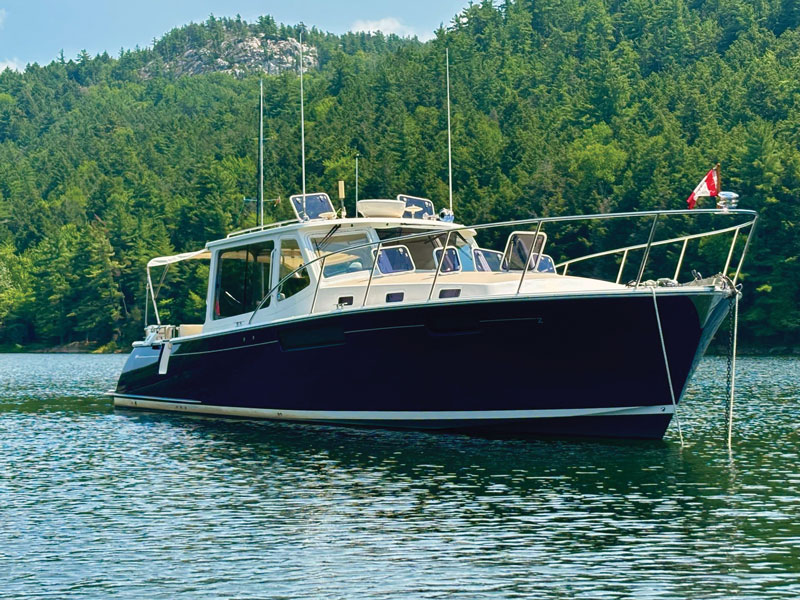
What follows is the series of social media posts that I made last summer as the trip progressed. Rather than a point-to-point narrative, these posts are a reflection on the experience of cruising to and from the Great Lakes. In them, I tried to capture the joys, frustrations, and feelings of voyaging onboard our remarkable powerboat.
Departure
Leaving on a long voyage is eternally the same. Weeks of planning precede the last-minute engine checks, the push of the ignition button, and the burbling of the engines. Calm study and anticipation give way to nervousness and butterflies. To-do lists have been checked off, amended, recreated, and checked off again. That orderliness, no matter how thoughtful and considered, surrenders to haunting thoughts that something has been forgotten that will be remembered at the moment when needed most or, more likely, while enjoying a lazy sundowner at anchor.
Anodyne gently noses out of her slip into a slight drizzle on an overcast and uninspiring morning. We hover partway out and remove our dock lines from their home pilings. The calm of the routine of departure settles in. Fenders are brought onboard and stowed. The engines rev out of idle to no wake speed. We glide comfortably through Lake Ogleton and out the entrance channel. The throttles are pushed forward, the turbos kick in, and Anodyne leaps to a plane, eager for adventure.
It is always the same. And… we’re off!
Annapolis, MD, to Canajoharie, NY
It is a rule to come to the aid of a fellow boater in distress. The mind imagines a daring rescue on dangerous seas or perhaps a desperate grounding in high winds; the wrecked ship being driven higher and further onto a rocky lee shore with a fearful crew saved by the local life station. In either case, there is a union of good Samaritans and one in need.
Anodyne departs Annapolis with a favorable weather window to run offshore around the New Jersey coast. She pulls alongside in New York harbor to refuel and begins her journey up the Hudson River to the Erie Canal on her way to an exploration of the Great Lakes.
In the early years of the 19th century, a young country understood the need to bind its developing western frontier, a land of great prospect separated by the daunting barrier presented by the Appalachians, to the east which had only just established its nascent independence. George Washington explored the possibility that the Potomac River could provide that important link. But it was the Hudson, connected as it was to the Mohawk, that proved to possess the superior topography to unite distant lands just under exploration with the heart of a young nation.
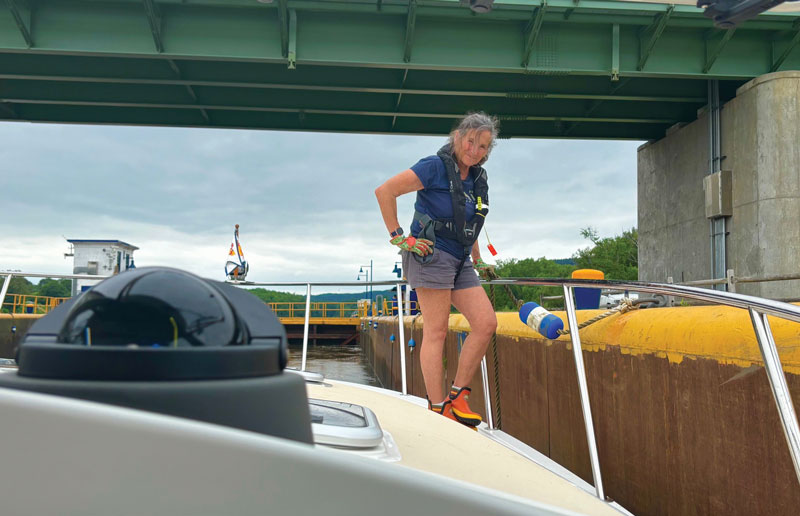
The Mohawk runs through a low gap between the Adirondacks to the north and the Catskills to the south. It had long ago provided a trading path for the tribes of the Iroquois Confederacy and today grants Anodyne safe passage along the Erie Canal on the Bicentennial of the construction of that hand-dug engineering marvel.
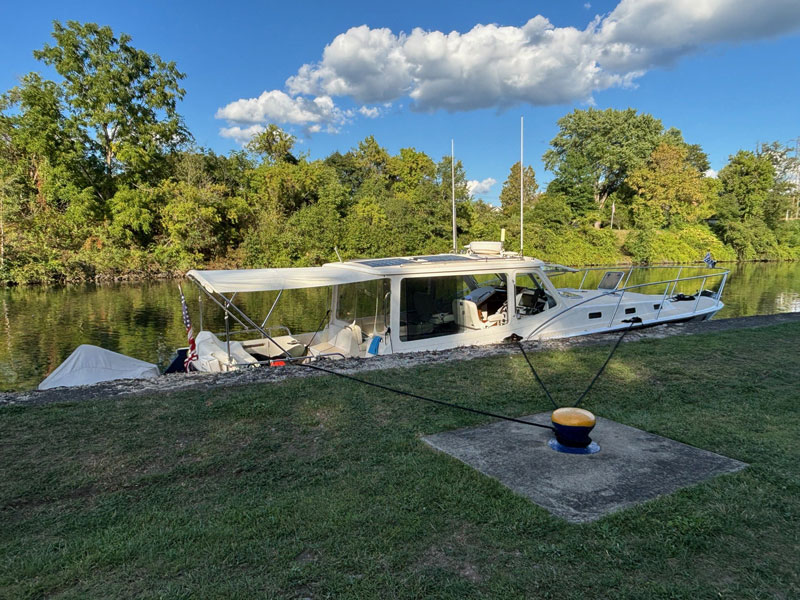
It was in Canajoharie that our short-lived voyage collapsed, a victim of a second canal closure. We tied Anodyne to bollards, originally intended for the barge traffic that long ago steadily moved freight along the Erie, and settled in to wait.
A bare concrete wall. No water or electricity. The heat reached 100 degrees. Six boats, including our close friends on Caribee II, Martha and Peter Boudreau, were stranded. And then, we became “boat people.” A fuel truck arrived to replenish empty diesel tanks. Restaurants opened their doors and welcomed us into their air-conditioned spaces with offers of ice water; no meal required. The fire department’s pumper drove in, its tank brimming with fresh water. Mariah, the deli girl, offered rides to anyone to anywhere. An anonymous old man, slowly and carefully, placed a gallon jug of fresh water on the wall beside all six boats, each jug representing a methodical journey to and from his aging Ford.
Like a shipwreck of sorts, the locals in Canjo came to our aid reminding us that it is not only trade routes that bind our great country together, but more importantly it is the kindness of strangers. They were our Samaritans, and we are grateful, and better, to have experienced the simple thoughtfulness of their generosity.
The Erie Canal
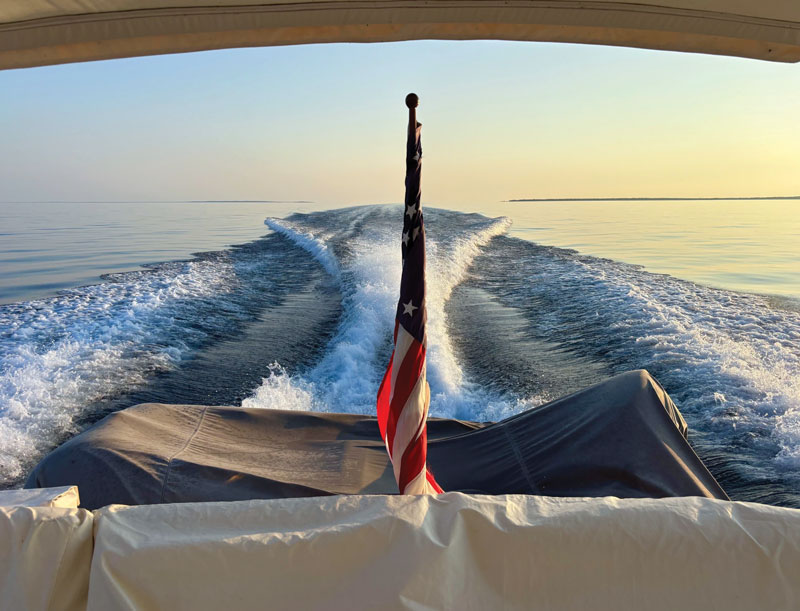
Anodyne hates to run at 10 mph, the predominate speed on the canal. Her stern squats, her engines seem to strain, fuel efficiency is dismal and depresses her, and she throws off a large, unseemly wake. None of this is appropriate for a lady of her elegance. She throttles down to the low 1300s, about 9 mph, and settles into a more comfortable rhythm, gracefully taking in the sights, but still miffed that she can’t run at the 30 mph where she shows off her plane with the merest of high-speed wakes.
The canal has not been kind to Anodyne. It insulted her with breakages that delayed her exit and infested her with spiders, ants, and other unnamed and uninvited guests. Her engine intakes clogged with debris and other vegetative matter stained her formerly unblemished decks. Her fender covers, there to protect her beautiful topsides, were simply a disaster, slimed as they were with the odious goo that cakes the canal’s lock walls.
But, she loved the history. The sight of the ruins of abandoned aqueducts, the man-made rock cuts that spoke of the tremendous and arduous labor that created the waterway, and the simple length of it all, 350 miles of passageway that bound together a young country, one just finding its way.
After the last lift bridge repair, she emerged from the canal, threw her throttles forward, and showed off her speed, her manner, her true self. She docked. Her owners cleaned, inspected, and made her right. She smiled. Tomorrow, the Great Lakes!
Buffalo, NY, to Tobermory, ON
Anodyne launches onto a plane, stretching her legs, exercising her engines, flaunting her wake. She is released from the confines of the Erie Canal and is eager for westward exploration, for new horizons, for adventure.
Lake Erie welcomes her with flat seas and accommodates her need for elegant speed. Five quick days find her in Tobermory, Ontario; past Lake Erie, the Detroit River, Lake St. Claire, the St. Claire River, and up Lake Huron to the entrance to Georgian Bay.
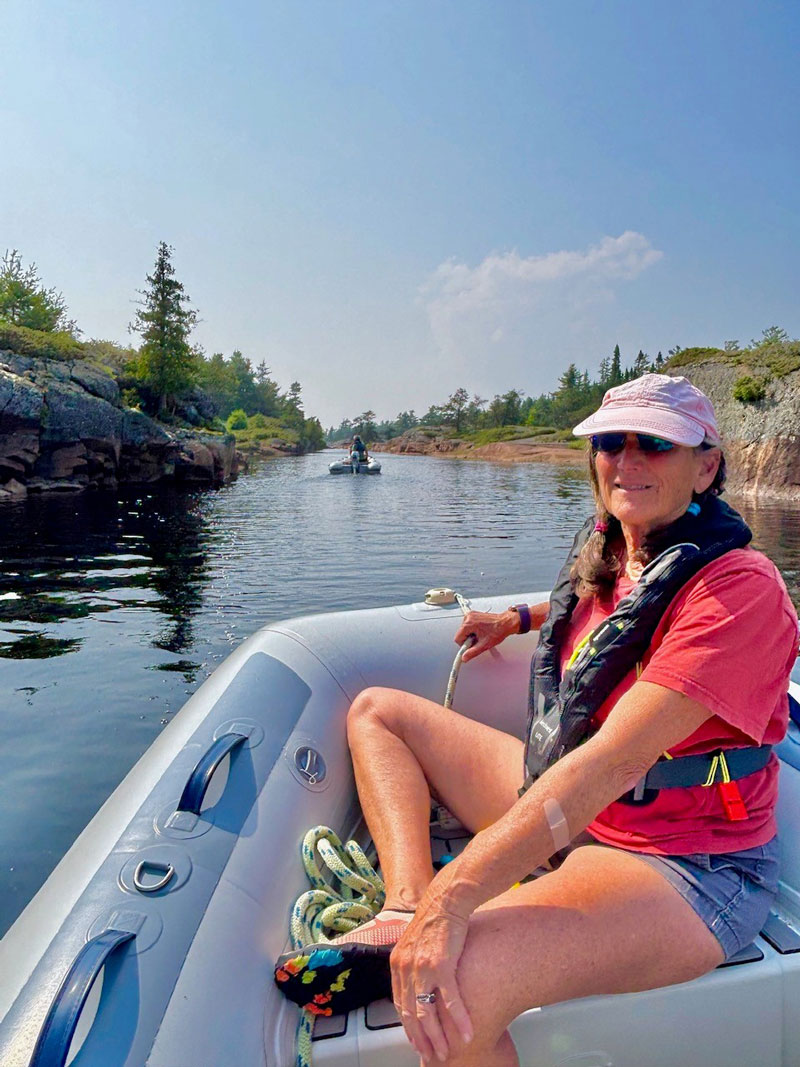
We relax. The need to push is over. We are here. This is what the trip is about—granite adorned with twisted white cedar, roots grasping at a hint of topsoil, the wildness of Crown and First Nations land, and clear, clean, fresh water.
Georgian Bay and the North Channel
The Great Lakes are remarkable. Formed by glaciers and filled by glacial melt eons ago, the water here is ancient; a minuscule one percent of this life-giving commodity is accumulated rain. The remainder of this huge and precious repository has been here since the beginning of time, comprising 20 percent of this world’s fresh water.
Anodyne idles her way out of Tobermory Harbor and throttles up into the short, steep chop characteristic of the lakes. The intricate passages of the 30,000 Islands and the remote anchorages of the North Channel are ahead of her. Nervous, but prepared, she points her bow toward unknown and new shores.
Daily, we weave through a labyrinth of watery passages. Channels, some as narrow as our beam, demand absolute focus and care with each tiny adjustment of the helm. We are surrounded by granite islets and rocks, most but not all marked on the charts, and every single one a threat to Anodyne’s vulnerable pods and props.
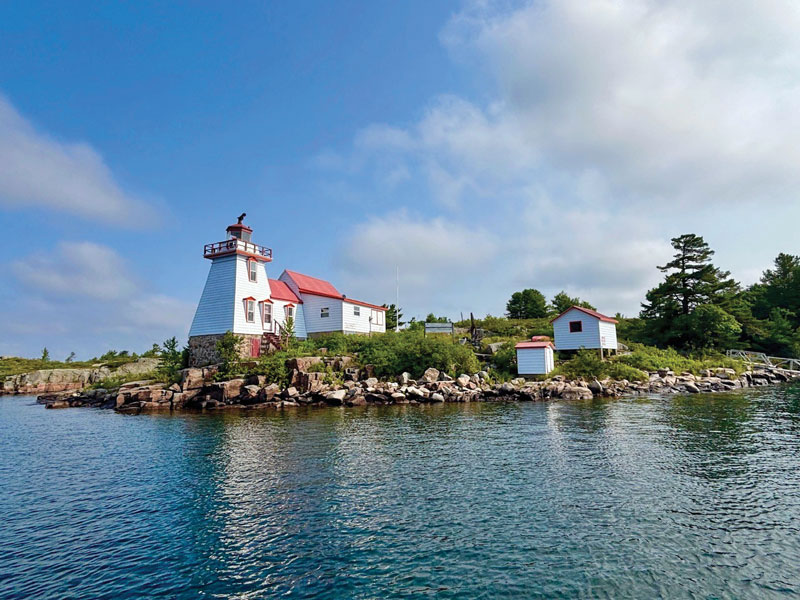
Like the water that supports our journey, the granite is ancient and is among the oldest known rock on this globe. It is a basement rock and forms the very foundation of our continent. Its exposure, to our eyes and Anodyne’s propellers, is the result of the same retreat of the massive mile-thick Laurentide glacier that created these Great Lakes.
We find our way into secluded anchorages each evening seeking rest from the tension of the day’s navigation. We drop and check the set of the anchor carefully and with caution. We abandon coves where the anchor can only find a rock bottom with no grab at all. We fear finding the odd deadhead, waiting beneath the surface to snare our hook.
At anchor there is a silence. Not a complete quiet, but a solemnity interrupted by wind, water, and the background chatter of birds calling in the near distance. The stillness reflects and mirrors a star-filled sky.
Our days underway are short, perhaps two or three hours. We take our time, preferring dinghy exploration over mileage and the discovery of another perfect anchorage over a distant marina. We enjoy evening social hours with fellow cruisers; the friendly conversation and sometimes a guitar and song.
We had thought to venture beyond Georgian Bay and the North Channel. Now, we don’t want to rush. Fall comes early here with the weather changing for the worse. The season’s end has risen above our horizon. We will need to consider the homeward trajectory soon. Perhaps the perfection of this part of Lake Huron is enough.
North Channel to Boyne City, MI, and Return
We ride in silence, Anodyne humming along at 27 knots, her engine readouts all normal, a long run south down Lake Huron. The lake is flat and Anodyne is eagerly eating up the miles before a forecasted southerly sets in later in the day. Already, wisps of a breeze are appearing on the surface, marring what was a dead flat calm.
After a stop in Michigan for routine engine service, we abandoned our goal of exploring Lake Superior. It is a huge lake, and we felt an exploration this late in the season would be rushed and inadequate (already we are seeing a change in weather patterns where settled high pressure has been replaced by more frequent lows).
We returned instead to the North Channel where, among the many islands and anchorages of the channel’s east end, we found a calm and satisfying sameness to each day. We settled into the routine of cruising where weather, small chores, navigation, and perhaps a game of cards defined the otherwise indistinguishable hours after dawn. We and Anodyne relaxed, unaware of the date or the day.
Our runs underway in the channel were short, rarely more than a few miles. We enjoyed the beauty and wilderness of the Canadian shoreline as we gunkholed from anchorage to anchorage, our decks streaked with a stubborn mud, a testament to our journey.
It was perfect cruising. Each day was the same, a repetition of its predecessor, a familiarity with its rhythm. And, each day was a blessing, a gift that we were lucky to unwrap and enjoy with the rise of a new sun.
Sarnia and Home to Annapolis
And then, just like that, Anodyne’s voyage to the Great Lakes ended. The abruptness of that finality disorients and confuses her crew. Months of planning routes and struggling with the weather are suddenly replaced by a sense of nothingness. Old land habits are hazy and difficult to recover from the depths of minds that have focused elsewhere on an immediacy that happily and necessarily characterizes cruising.
Anodyne ran easily from Lake Huron down the St. Clair and Detroit Rivers to Vermilion, OH, on the western Erie. There, she was weathered in for five days before she could find her way east across the Lake to the Welland Canal. More adverse conditions prolonged her passage across Lake Ontario to the Thousand Islands at the entrance to the St. Lawrence River. Finally, she entered the Oswego Canal and the relatively protected waters that would surround her on the Erie Canal and the Hudson before an offshore run around New Jersey and then home to Bay Ridge.
The mind finds it difficult to locate the correct light switch and to recall the day of the week on which to deliver the trash to the curb. We return to Anodyne often, more for the comfort of her protective presence than to complete the chore that sent us to her slip.
We are home. The to-do list grows daily as we refocus our lives. We see our neighbors and friends. We look forward to visits with our children. And, we know the familiar struggle to find peace after a long voyage will be slowly replaced by the joy and satisfaction of returning home safely.
By Alex McCrary with Corky Piwoz