We recently caught up with Jeremy St. Pierre who, along with his wife, Marsha, owns a 1971 26-foot Brownell Bass Boat named Milo. They have owned her for three seasons now, and while it can sometimes take quite a bit of extra work to keep her seaworthy, they both wholeheartedly agree that owning a classic boat is worth it.
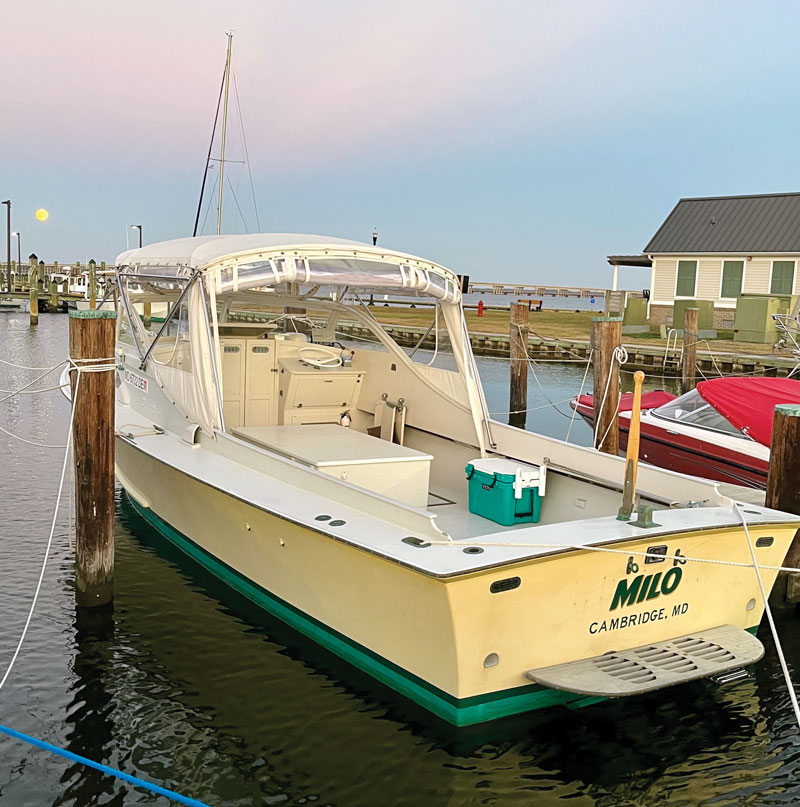
Jeremy used to live in Rhode Island and at one time even owned a 26-foot Manuel Parece bass boat. He remembers how great it was for day tripping and picnicking, but then they sold the boat and they were boat-less again until the winter of 2022. He remembers thinking, ‘we should buy a boat…’ and so it began. “I started looking around,” he says, “and I thought, ‘I used to have a bass boat and that was a good boat.’”
After some searching, they found one up in Mystic, CT. It was in good shape, and they learned that Thomas Townsend Custom Marine Woodworking had done a bunch of work on the boat. They decided to buy her that winter and had her trucked down for delivery in March of 2023.
Jeremy has worked with Generation III Marina in Cambridge, MD, since taking delivery of the boat and had nothing but good things to say about them. He says, “The folks at Gen. III said, ‘we can put her on stands if you want, but let’s put her in the water and see what happens’ so we did.”
The boating season in Cambridge (and most places on the Bay) doesn’t really kick off until May, so it being March, it was still quite cold and quiet, but that first month of ownership allowed Jeremy to start to get to know the boat.
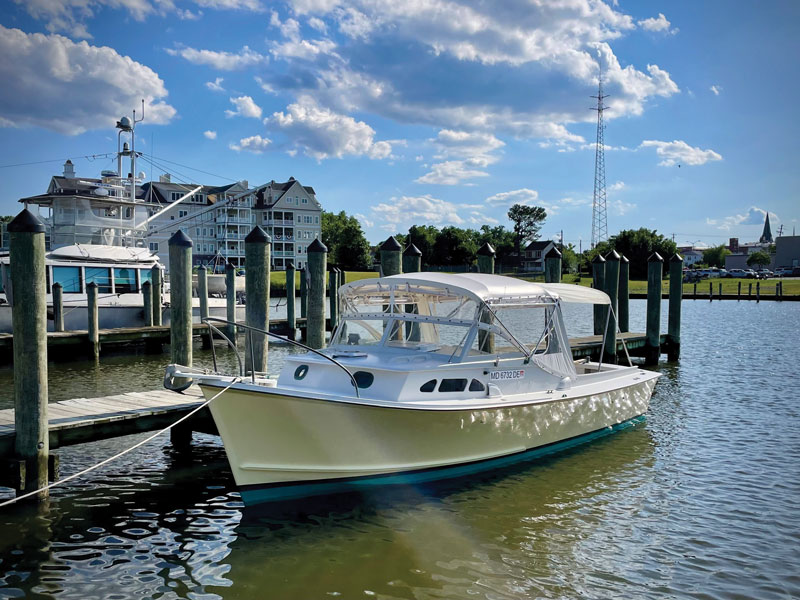
“I think we probably put 80 or 90 hours on her that first season, and she was great,” says Jeremy. “We had a few problems, which you always do, but we got to know the boat a little bit better. We did a couple of overnights on her, and we took her out fishing and had lots of picnics. I keep the boat in Cambridge Yacht Basin which is about a 15-minute walk from my house.”
For Jeremy, the proximity to Milo is a real treat. “It’s great to walk down there and go have a coffee or just hang out on the boat,” he says. “I say ‘I’m gonna go check on Milo,’ which basically means I’m going to goof off for an hour on the boat and my wife is like ‘totally, excellent, take the dog,’ and it’s nice. It’s a great hangout spot.”
But as great that sounds, we know from past interviews that classic boats aren’t all fun and games. They are a labor of love and owners often face costly repairs. Jeremy helped to put it into perspective.
“You don’t want to get too hung up with having to have your boat restored,” he says. “You’ll need deep pockets for that. But if the boat is fundamentally sound with decent owners over the years and there are no real big issues, then they aren’t super expensive. Just know that while you generally pay less upfront, you also sort of pay by the year, and your yard bills will be a little bigger.”
In chatting about yearly bills, Jeremy explained how they found a few issues with Milo early on and they caught them “at the nick of time.”
They noticed some diesel in the bilge, not a lot, but it was persistent, and it quickly became evident that the starboard tank was leaking. Jeremy says they looked high and low to try and figure out what was going on. They had hoped it was a fitting or something small, but the only way to know for sure was to take up the deck and get a look at the bottom of the tank.
“So last year we made the commitment,” says Jeremy. “We talked to several people around here about doing the work and generally they went kind of quiet after they saw the extent of the project. They’d say, ‘That’s a big project’ and ‘You don’t know what you’re going to get into after taking up the deck.’”
In the end they chose Gen. III in Cambridge. Jeremy says they are a “great, old-school boat place, good guys. Maybe a little cool at first but they warmed up and treated us well.”
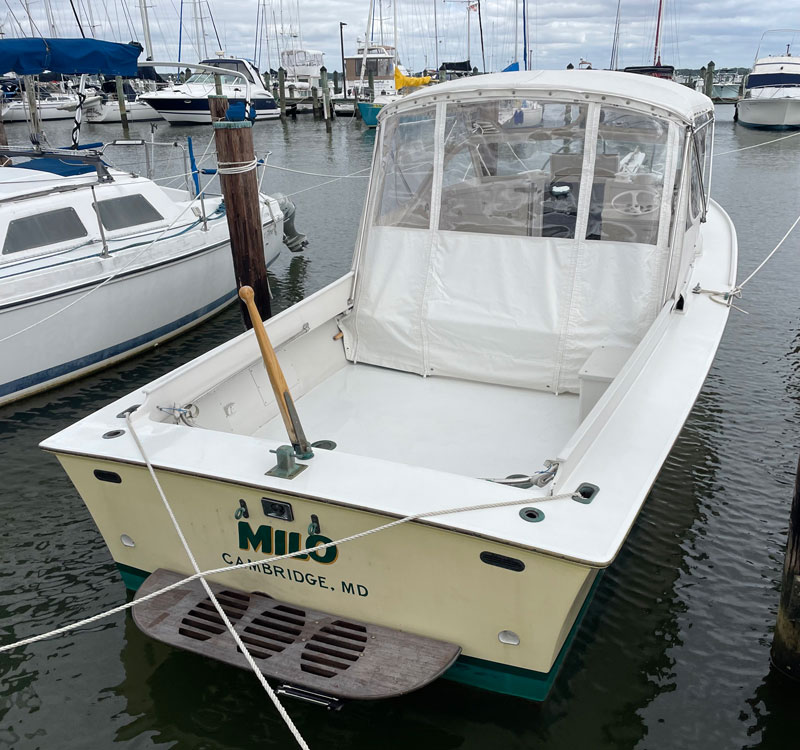
Thankfully, after taking the deck off, they found that it was in good shape. But as suspected, there was a problem with one of the fuel tanks. They were both original, and one definitely had some rot in the bottom. So, they took both tanks out and had two new ones made and reinstalled. And since the boat was already open, they checked the rest of her out.
Jeremy says, “The frames were good, the planking was great. The floors and stringers were in excellent condition. So, for a 50-year-old girl, she’s in remarkable condition.”
They discovered that the rail around the boat was reaching the end of its useful life, and since the boat was already inside being worked on, they added that project to the list.
“It was not an inexpensive process,” Jeremy jokingly admitted. But if they hadn’t done this, he explained how they would have had problems with water getting into the deck in the future, which would have been quite bad. It was a major repair, but definitely worth it.
After replacing the fuel tanks and completing a few more repairs (other projects included some work on the transom, drive line, and the propeller shaft), Milo has been running great.
Jeremy says, “The fuel mileage improved, she had a higher top speed and no diesel stink; we overnighted on her a bunch of times and she’s just a real treat.”
“It’s such a cool boat and we always get compliments; doesn’t matter where you go,” he added. “It’s not a real fast boat, maybe 15 knots top speed, and she cruises at about 12 knots. You can chug around at seven or eight knots and basically use no fuel. I did my fuel calculations for this year, and she uses only about two and a half gallons an hour; you can’t beat that.”
So how about the name Milo? It’s not one you hear all the time. Jeremy explained how he’s the fifth owner and the name changed each time. She was named Milo when he bought it and he didn’t want to change the name again.
“I thought, Milo is kind of an interesting name,” he says. “I haven’t come across a Milo before. All the other previous names had been wives’ names, but I thought Milo, that’s Greek, I’ll go with that.”
They had some humorous conversations given that Milo is typically a man’s name, but boats are usually referred to as ‘she.’ Jeremy says it was kind of “A Boy Named Sue” situation (the Johnny Cash song).
At the time that we chatted, Milo was about to be pulled for the winter season. They had a custom cover made for it so apart from taking all the canvases down and winterizing her, she’s ready to be tucked away for the winter. Next year Jeremy plans to blast the bottom to get the layers of bottom paint off and refinish it. They talked about painting the top sides, but Jeremy says, “She’s not a Hinckley picnic boat, as cool as those are. So, we’re not so worried about the boat aesthetically.” Jeremy and his wife love Milo just the way she is.
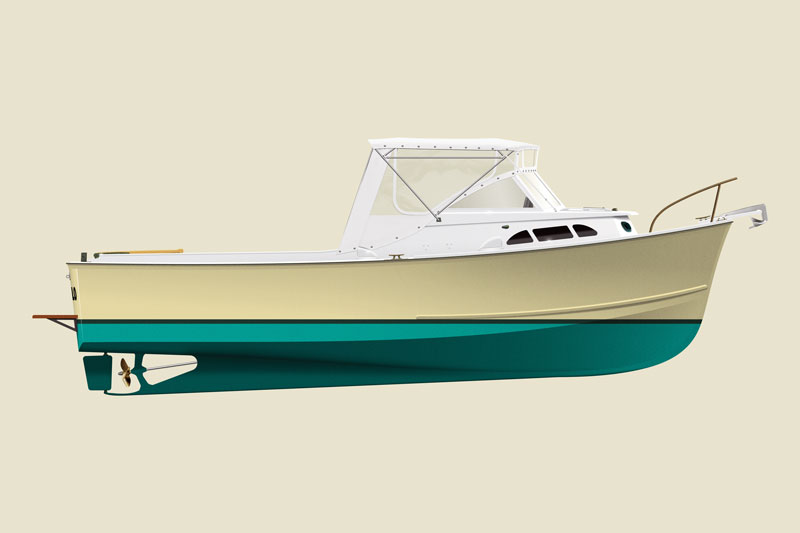
“We’re both retired,” he says. “It’s really nice for two people overnighting. And what’s also nice is that I can take her out by myself, and I can still manage her.”
Of course, I had to ask Jeremy if he had any advice for someone considering purchasing an older boat.
“I think there’s two things,” says Jeremy. “One, don’t think it’s an inexpensive way of getting a boat you otherwise couldn’t get. If someone thinks, ‘Oh, I can buy an old wooden boat for $25,000 and it’s a 50-year-old boat, there’s a reason. It’s probably going to need another $50,000 or more of work for it to even be safe.
“If you’re really handy, that helps. Like anything else, it’s kind of like working on a car or doing plumbing. It’s a lot harder than it looks. So, you really want to try and have a relationship with a yard; I think that’s imperative. I think you’ve got to know that it’s not all like it is in WoodenBoat Magazine where you buy a boat and restore it and it’s easy.”
“Be prepared to write some big checks,” he added with a laugh. But at the same time, it’s all about perspective.
Jeremy remembers meeting a guy who was restoring a boat and explained how it’s all about mind over matter. When he asked him what he meant by that, he said, “If I don’t mind, it don’t matter.”
To own a classic boat, you simply need a realistic mindset. Fix what needs to be fixed, but don’t always get so hung up on having a perfectly restored boat aesthetically if the vessel is structurally sound.
And at the end of the day, the investment has been worth it ten-fold for Jermey and his wife.
“There’s nothing like a wood boat,” he says. “They smell good when you get onboard (as long as you’re not leaking diesel), and they have a lovely motion. There’s just something about them. It’s so nice to be lying there in the bunk relaxing and looking up and seeing the wood structure that you know some guy cut and fit; it’s really nice to look at. It’s pretty good living.”
We couldn’t agree more!
By Kaylie Jasinski